Food Businesses as Cultural Memory-Keepers
Food Businesses as Cultural Memory-Keepers and Economic Engines
When the fires disrupted daily life across Altadena and Pasadena, people didn't just lose homes and routines. They lost kitchens. Tables. Familiar rhythms. The small, ordinary rituals that make life feel anchored.
In that disorientation, food businesses became something more than places to eat. Restaurants, bakeries, food trucks, caterers, and home-based chefs became places to gather, to check on one another, to exchange information, and to feel momentarily grounded. As one owner shared: "People came here to check on each other. It wasn't just about the food — it was the place people came to find out what was going on."
These spaces held more than meals. They held memory.
Food businesses sit at the intersection of culture and economy. They employ local residents, circulate dollars through neighborhoods, and carry the flavors, traditions, and histories that define a community. In moments of crisis, they also carry something less visible but just as vital: continuity. When everything else feels unstable, food becomes a way to remember who we are and where we come from.
But these same businesses were among the most severely impacted by the fires.
Every interviewed food business experienced revenue loss. Many lost inventory to smoke contamination or spoilage. Nearly seventy percent saw catering and event-based income disappear overnight or lost access to commercial kitchens. For some, the disruption was significant enough to pause or fully shut down operations.
This pattern is not unique. Similar wildfire-impacted regions like Santa Rosa and Sonoma County saw food enterprises lose between 30 and 70 percent of revenue following displacement and contamination. The loss is not only economic. It is cultural. When food businesses falter, communities lose gathering places, shared memory, and a sense of normalcy that money alone cannot replace.
When Food Infrastructure Fractures
The fires did not just destroy structures — they destabilized an already strained food ecosystem. As one resident, Amber, explained, even before the fires there were limited grocery options nearby. Afterward, access became even more fragile. What remained were stores with limited or culturally narrow offerings, forcing residents to travel farther for fresh, quality food — often while displaced, under financial strain, and without reliable transportation.
Recovery, in this context, is not just about reopening doors. It is about restoring everyday infrastructure — the systems that support health, dignity, and daily survival.
The Hidden Cost of Eating Without a Kitchen
For families without access to kitchens, the financial burden compounded quickly. "People had to eat out every day because they didn't have a kitchen," one resident shared. Another described the accumulation: weeks in a hotel, daily meals purchased instead of cooked, routines disrupted beyond recognition.
Food insecurity in crisis is rarely just about scarcity. It is about cumulative cost, lost autonomy, and the emotional weight of not being able to feed your family in familiar ways.
When Emergency Food Misses the Mark
Emergency food aid, while essential, often failed to meet cultural and nutritional needs. "Your diet is changing because you're eating all these donated items that are not within your typical diet," one resident explained. Over time, that mismatch took a toll — on physical health, mental health, and self-worth.
Food is identity. Food is memory. In moments when people lose homes, belongings, and routines, culturally aligned food becomes one of the last remaining anchors. When aid overlooks this, it unintentionally deepens harm.
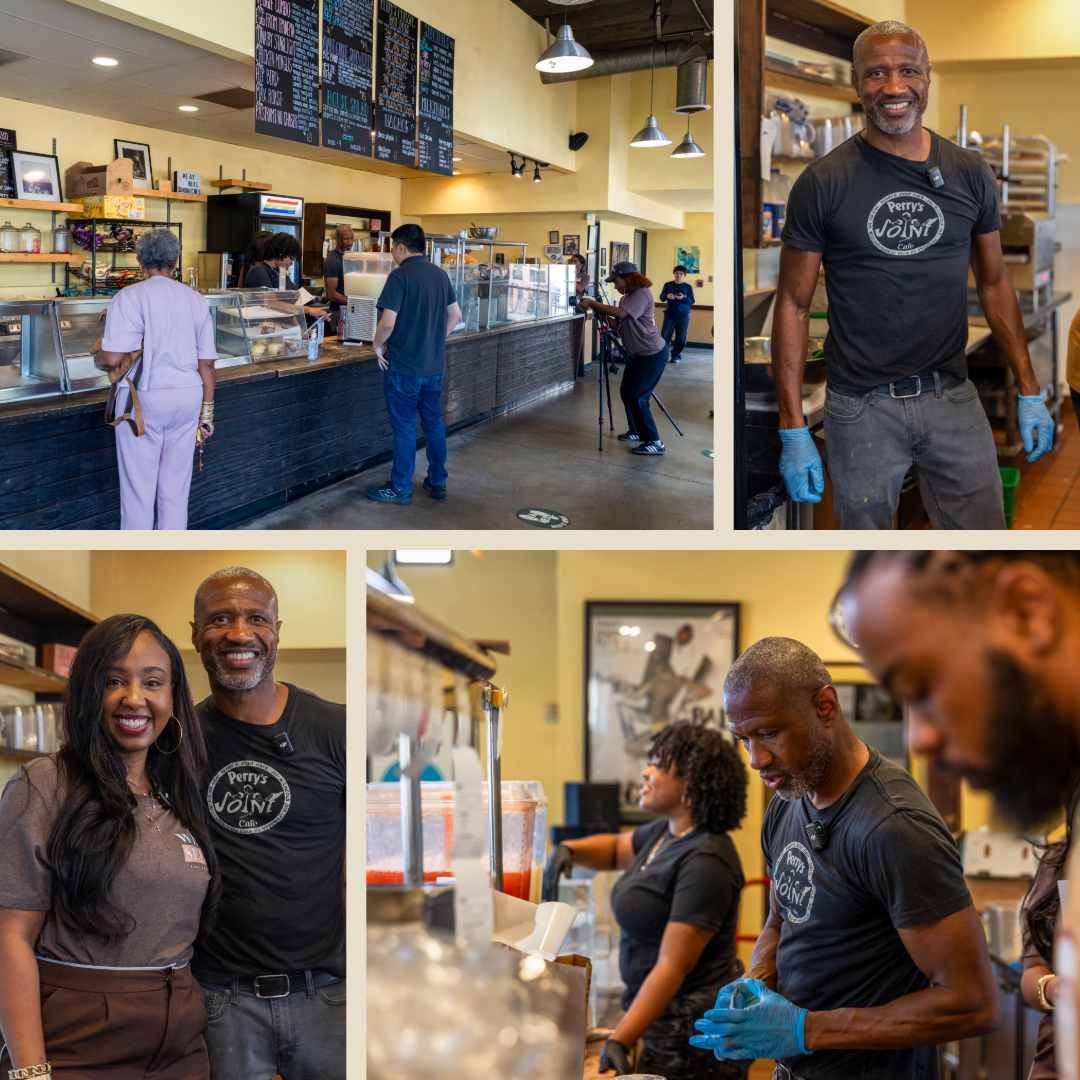
Perry's Joint Cafe: A community anchor for food and connection.

The Yard LA: Preserving culinary heritage and community space.
What Works Elsewhere
Examples from other regions point to durable approaches. In San Francisco, La Cocina supports women-of-color-owned food businesses through shared kitchens and incubation models that protect both culture and livelihoods. Portland Mercado demonstrates how community-owned food districts can preserve identity while building economic stability. In Los Angeles, Little Tokyo's legacy business protections and community land stewardship show the impact of treating cultural institutions as essential infrastructure.
Across these models, shared space, cooperative systems, and community ownership emerge as foundational components of resilient food ecosystems.
Key Recommendations for LA County
1. Food Ecosystem Recovery & Resilience Fund
Establish a dedicated fund providing working capital, equipment replacement, smoke remediation, recoverable grants, revenue-based financing, and micro-insurance options — designed to stabilize food businesses without pushing them into deeper debt.
2. Community-Owned Food Heritage District
Modeled after Portland Mercado and La Cocina, an Altadena–Pasadena district could offer stabilized rents, shared kitchens and cold storage, cooperative distribution, community food markets, and partial ownership opportunities for vendors. This protects culinary heritage while supporting long-term economic continuity.
3. Olympic Food Vendor Accelerator (LA28)
Ensure Black, Brown, immigrant, and women-owned food businesses can access LA28 procurement through compliance support, cooperative bidding structures, shared insurance pools, menu scaling, and packaging assistance — positioning local food culture on a global stage.
4. Cooperative Supply Chain Solutions
Reduce vulnerability through group purchasing clubs, pooled distribution, shared storage, and regional supplier mapping across the Foothills and Northeast LA — building resilience before the next disruption arrives.
Toward a Resilient Food Ecosystem
In the aftermath of the wildfires, a network of food entrepreneurs, grassroots organizers, relief funds, and public agencies stepped in to stabilize access, culture, and daily life. Together, they protected far more than individual businesses—they sustained the region's food infrastructure at a moment of acute disruption.
Food businesses functioned as both economic engines and cultural memory-keepers, providing continuity when familiar routines were fractured. Their survival is not only a matter of economic recovery, but of preserving community identity, health, and dignity.
For funders and system-builders, the implication is clear: equitable recovery depends on resourcing the food ecosystem as a whole—entrepreneurs, shared kitchens, cultural corridors, and community intermediaries. Treating food infrastructure as essential civic infrastructure is foundational to resilient recovery and long-term stability.